Turning Operational Chaos Into Scalable, Executable Systems
For founders and teams ready to replace scattered processes with structured systems, clear workflows, and aligned execution.
Operations Consulting | Systems Strategy | Team Training & Development
Bring one process or SOP. We’ll break it down and start building the system, live.
Why It Starts With Execution
Most businesses don’t have a strategy problem. They have an execution problem.
Systems exist, but they aren’t structured.
Teams are working, but nothing is aligned.
That’s where I come in.
What I Do Best
I fix what isn’t working inside businesses.
Not on the surface.
Inside the systems, workflows, and structure that determine whether a business runs smoothly or constantly feels like chaos.
I’ve built and scaled businesses. I understand what it takes to keep everything moving.
But my strength isn’t in running everything.
It’s in stepping in, identifying what’s broken, and building the systems that make execution possible.
I design operational structure.
I implement workflows.
I create clarity where there isn’t any.
I’m not here to be the face of your business.
I’m here to make sure it works.
This is the work you’ll see throughout my portfolio and the approach behind every 30-Minute Operational Fix Session.
Focused. Intentional. Built around what actually works.
Built Through Experience,
Refined Through Execution
I’ve spent over 20 years building, improving, and optimizing systems, long before I ever called it operations.
At 9, I created and sold handmade products door-to-door; learning early how to take ownership and follow through.
At 12, I managed a fully booked babysitting schedule; balancing demand, time, and responsibility.
At 14, I entered the workforce and quickly moved into leadership; learning how to manage people and performance.
By 19, I was training teams, improving systems, and working alongside leadership to optimize operations at scale.
Over time, I pushed myself beyond sustainable limits and learned the hard way that effort alone doesn’t create stability.
Structure does. Systems do.
That’s the difference I bring into every business I work with.
Where It All Came Together
One of the most defining chapters in my career was with InDemand Services.
That’s where everything clicked.
I stepped into a recruiting role, intentionally avoiding management for a short time.
But it didn’t take long.
I naturally moved into the work I do best, improving systems, supporting teams, and optimizing how things function behind the scenes.
Within months, I was:
Training recruiters and improving team performance
Working with engineers to enhance a custom ATS
Streamlining hiring processes and job workflows
Overseeing scheduling operations across the team
Advancing into a Director of Operations role
That experience gave me something most roles don’t, the ability to think, improve, and execute inside a business at every level.
It shaped how I approach operations today.
Not from college. From experience.
What I Bring to the Table
I don’t just identify operational problems. I fix them at the system level.
Streamlined Operations
What:
I identify where your operations are slowing you down, creating confusion, or causing unnecessary manual work.
How:
We break down one real process, remove friction points, and restructure it into a clear, repeatable workflow your team can actually follow.
Build and Optimize Systems
What:
I ensure your systems are not just set up, but set up to support how your business actually runs.
How:
During the session, we review how your tools are being used, identify gaps, and begin aligning them with your workflows so everything connects properly.
SOPs Teams Actually Follow
What:
I turn inconsistent processes into structured SOPs that are clear, usable, and relevant to each role.
How:
We take one process and define it step-by-step in a way that removes guesswork, making it easier for your team to execute without constant oversight.
Train Teams Based on Their Roles
What:
I help ensure your team understands not just what to do, but how to do it within your systems.
How:
I structure processes in a way that naturally supports training, so each role has clarity on expectations, responsibilities, and execution.
Improved Efficiency, Tracking, and Performance
What:
I identify where performance is unclear or inconsistent due to lack of structure.
How:
We establish simple ways to track progress, improve visibility, and ensure your operations support consistent results.
Systems don’t succeed without people who understand and trust them.
That’s why everything I build is designed to work in real life, not just on paper.
About the 30 Minute Operational Fix Session
This is a focused, hands-on working session.
We don’t talk about ideas, we work on what’s actually happening inside your business.
1. Identify the Right Problem
We start by reviewing the process or SOP you bring to the session.
Not surface-level, what’s actually breaking, slowing things down, or causing confusion.
2. Break It Down
We walk through the process step-by-step to uncover gaps, inefficiencies, and disconnects between your systems and your team.
3. Fix and Restructure
We begin restructuring the process into something clear, usable, and aligned with how your business actually operates.
4. Start Building the System
This is where execution happens.
We begin implementing the changes so you leave with real progress, not just notes.
5. Define Your Next Steps
You’ll leave knowing exactly what to do next, what to prioritize, and how to continue building from what we started.
You don’t need another strategy. You need something that works.
This Is For Your If:
You have an existing business, process, or system that isn’t working the way it should
You can clearly identify at least one operational issue or breakdown
You’re ready to take action, not just talk about ideas
You want structure, clarity, and systems your team can actually follow
You value execution and are open to making real changes
This Is Not For Your If:
You’re looking for general advice, brainstorming, or “just picking my brain”
You don’t currently have a process, system, or SOP to work on
You’re not ready to implement changes or take action
You’re expecting a full business build-out in 30 minutes
You prefer high-level strategy without execution
Blogs & Articles

October 2026 Business Trends 🎃 What Matters Now & What to Do Next
🎃 October 2026 Business Trends: What Matters Now & What to Do Next
Welcome to your October 2026 Business Trends Briefing from Business Master Suite.
This month, we're shining a flashlight on some of the things that may be hiding in the dark corners of your business.
AI being used without clear rules. Processes that haven't caught up with technology. Customers taking a harder look at value. Security vulnerabilities hiding inside everyday operations.
Sounds a little spooky, right? 👻
Each month, we break down relevant shifts happening across business, automation, and operations, not just what's changing, but how to respond without overcomplicating your business.
So grab your flashlight. 🔦
Here's what matters right now.
🎃 What's Trending This Month | October 2026
1. 👻 AI Is Growing Faster Than Business Policies
AI adoption is moving quickly, but many businesses are still figuring out the rules around how employees should actually use it.
When AI becomes part of everyday work without clear expectations, businesses can unintentionally expose customer information, internal documents, proprietary processes, or other sensitive information.
The goal isn't to be afraid of AI.
It's to make sure your business is using it intentionally and responsibly.
🎯 Do This Now
Make a list of the AI tools currently being used throughout your business. Then establish basic guidelines defining what company and customer information can and cannot be entered into those tools.
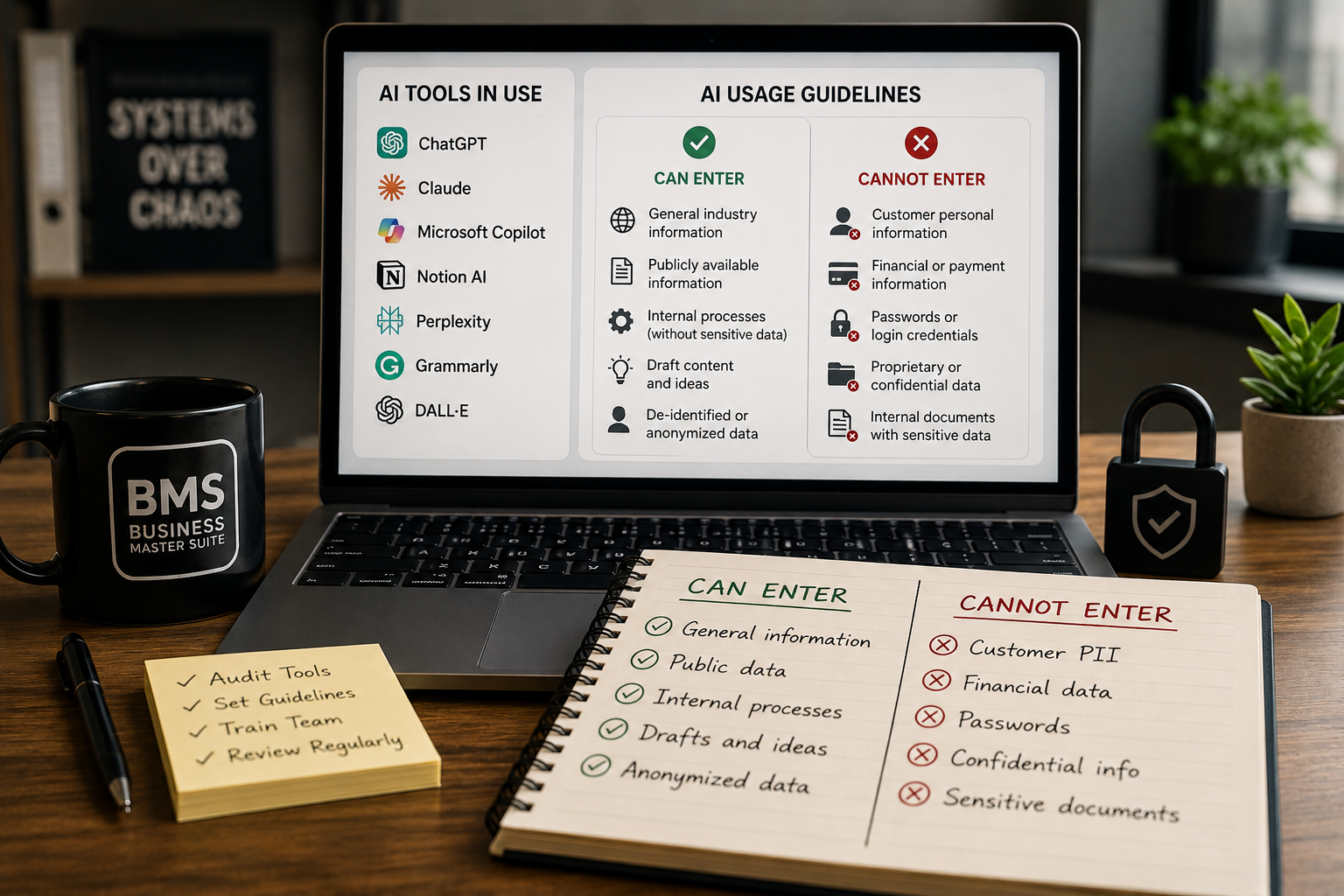
2. 🧟 Businesses Are Moving From "Playing With AI" to Actually Using It
Experimenting with AI is easy.
Integrating it into an actual business process is different.
The shift we're watching is businesses beginning to ask a much better question:
Where can AI actually save us time or improve an outcome?
Instead of using AI randomly, businesses are beginning to look for practical places to incorporate it into repetitive tasks, administrative work, customer communication, documentation, research, marketing, and internal processes.
That's when AI stops being another shiny tool and starts becoming part of your system.
🎯 Do This Now
Pick one repetitive workflow and measure how long it currently takes. Test whether AI can reduce the time required without reducing the quality of the final result.
Don't automate everything.
Start with one thing.

3. 🎃 Customers Want Value, Not Just a Lower Price
Customers are paying closer attention to where their money goes.
But competing on value doesn't necessarily mean becoming the cheapest option.
Customers may evaluate the entire experience:
Is this convenient?
Can I trust this company?
Do they communicate well?
Will this actually solve my problem?
Is working with them worth what I'm paying?
That means businesses need to clearly communicate why they're worth choosing, not simply what they sell.
Your systems, customer experience, communication, reputation, and marketing all contribute to perceived value.
🎯 Do This Now
Look at your website and marketing from a customer's perspective.
Can someone understand within a few seconds:
What you do.
Who you help.
What makes working with you valuable.
What they should do next.
If not, simplify the message.

4. 🕸️ Cybersecurity Is Becoming an Operations Problem
Cybersecurity isn't something only large companies or IT departments need to think about anymore.
Small businesses operate through email accounts, cloud software, CRMs, payment platforms, shared documents, mobile devices, AI tools, and dozens of logins.
That means cybersecurity is becoming part of everyday business operations.
One forgotten employee login or compromised account can become a much larger problem.
And as AI makes scams and phishing attempts increasingly sophisticated, employees need to know how to recognize when something doesn't look right.
🎯 Do This Now
Conduct a simple access audit.
Check your major business systems and:
• Remove former employees and unnecessary users
• Review administrator permissions
• Enable multi-factor authentication where available
• Update shared or outdated passwords
• Make sure employees know who to contact when something suspicious happens
You don't need to become a cybersecurity expert.
You need basic systems that reduce unnecessary risk.

👻 What's Hiding in Your Business?
Sometimes the scariest business problems aren't the big, obvious ones.
They're the little things happening quietly every day.
A lead that never received a follow-up.
An employee who wasn't properly trained on a process.
A customer waiting because everything has to go through the owner.
An AI tool being used without anyone establishing rules.
A former employee who still has access to a system.
Marketing that tells people what you sell but never explains why they should choose you.
A manual task someone completes every Friday that could have been simplified months ago.
Individually, these may seem small.
Over time, they can quietly steal time, money, opportunities, and capacity.
This month, don't just look for what's new.
Look for what's been hiding. 🔦

📌 What This Means for Business Owners
If there's one takeaway this month, it's this:
The biggest threats to your business aren't always obvious. They're often hiding inside the processes, technology, and habits you've stopped questioning.
You don't need to chase every new tool or tactic.
And you definitely don't need a Frankenstein system stitched together from 15 different platforms that barely communicate with one another. 🧟
You need clear systems, intentional decisions, trained people, and the right technology at the right time.
That's where momentum is built.
⚡ Your Monthly Action Prompt
Set aside 30 minutes this week and ask:
What's hiding inside our business that we've been meaning to fix, simplify, document, secure, delegate, or automate?
Don't try to tackle the entire haunted house at once.
Pick one room. 🔦
Choose one problem.
Investigate what's happening.
Determine why it's happening.
Then decide what needs to change.
One improvement at a time.
If you want another set of eyes on it, text (984) 237-2621 and tell us what you're working on.
We often feature real responses, with permission, in future issues.
🕸️ Don't Let Problems Collect Cobwebs
Sometimes you already know something isn't working.
You just haven't had the time, resources, or outside perspective to figure out why.
That's where Business Master Suite can help.
Our work focuses on Systems, Operations, Marketing, and Training, because those areas are often more connected than they appear.
What looks like a technology problem might actually be a training problem.
What looks like a marketing problem might actually be a follow-up problem.
What looks like an employee problem might actually be an undocumented process.
And what looks like an automation problem might simply be a workflow that needs to be fixed before it's automated.
Our goal isn't to add more complexity.
It's to help you determine what's actually happening and what makes sense to do next.
If something inside your business has been driving you crazy, text (984) 237-2621 and tell us what's going on.
Due to the high volume of calls we receive, texting is the best way to reach our team.
👀 What's Creeping Up Next?
Throughout October, Business Weekly will dig deeper into the trends we're discussing this month:
• Creating practical AI guidelines for your business
• Moving AI from experimentation into actual workflows
• Strengthening the value customers see in your business
• Cleaning up system access and basic security practices
• Tactical strategies you can actually implement
Think of the Business Trends Briefing as your monthly overview.
Business Weekly is where we start putting it into action.
📩 CLICK HERE to sign up for Business Weekly and receive our weekly business insights directly in your inbox.
Don't forget to add [email protected] to your safe-senders list so our emails don't mysteriously disappear. 👻
🎃 What's Haunting Your Business Right Now?
A broken process?
Too much manual work?
Technology that isn't working together?
Marketing that isn't producing results?
Training that needs improvement?
Text (984) 237-2621 and tell us what you're seeing.
This briefing is built for real business owners, not headlines.
To smarter systems and fewer business nightmares,
Business Master Suite
Smarter systems. Better decisions. Stronger businesses.

Testimonials
People Love Us

Lorem ipsum dolor sit amet, consectetur adipiscing elit, sed do eiusmod tempor incididunt ut labore et dolore magna aliqua. Ut enim ad minim veniam, quis nostrud exercitation ullamco laboris nisi ut aliquip.
Jane Doe


Lorem ipsum dolor sit amet, consectetur adipiscing elit, sed do eiusmod tempor incididunt ut labore et dolore magna aliqua. Ut enim ad minim veniam, quis nostrud exercitation ullamco laboris nisi ut aliquip.
Jane Doe
For Hiring Managers
I’m currently open to Director-level operations roles focused on systems, team development, and organizational structure.
Available for roles where execution, structure, and team alignment are critical to growth.